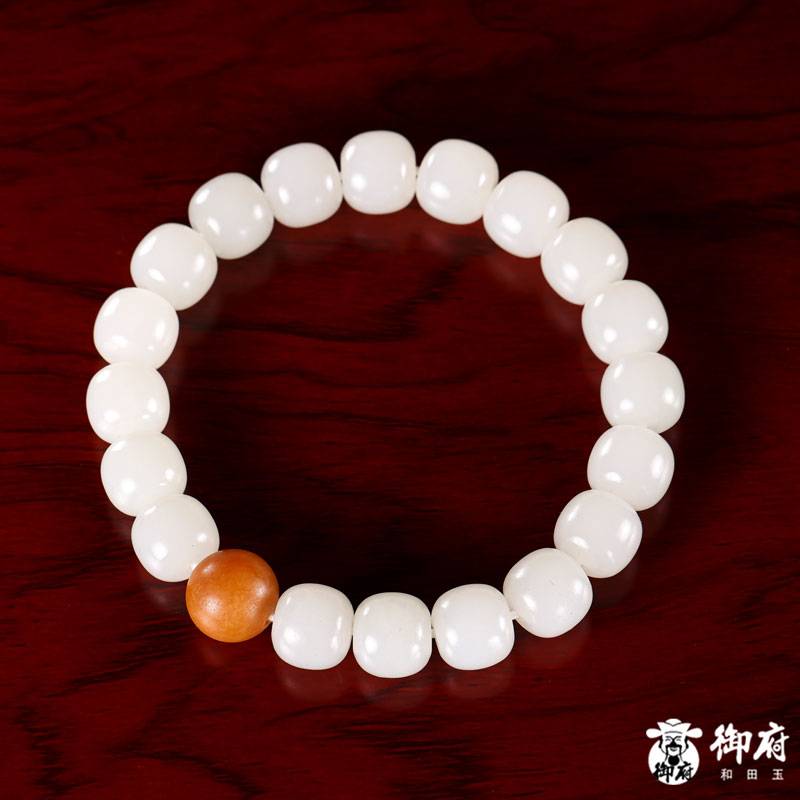
A detailed jade listing should help you separate recorded facts from interpretation. This guide uses two recent Yufu domestic archive records as examples: reference 90173, recorded at 28.3 g, and reference 90179, recorded at 30 g. Both source pages describe Xinjiang Hetian white seed-jade bracelets with reddish-brown skin, and both were visibly marked as already collected when we checked them on October 26, 2026. They are evidence examples, not current offers.
Archive status: neither reference work on this page is being presented as available stock. A machine-readable InStock value on an old source page does not override the visible sold or 已结缘 status.
Start by translating the title into separate claims
The two source titles combine several claims: Xinjiang, Hetian jade, white seed material, reddish-brown skin and bracelet form. Do not treat the whole title as one proof. Read it as a checklist of statements that may need different evidence.
- Hetian white jade is the stated material and colour family.
- Seed jade is the stated material-origin category, not something a title alone can independently prove.
- Reddish-brown skin describes the retained surface colour and texture seen in the source photographs.
- Bracelet identifies the assembled wearable object, but it does not provide wrist fit or total length.
Two archive records, compared fact by fact
| Recorded field | Reference 90173 | Reference 90179 |
|---|---|---|
| Visible source status | Already collected / archive reference | Already collected / archive reference |
| Source description | Xinjiang Hetian white seed jade with reddish-brown skin | Xinjiang Hetian white seed jade with reddish-brown skin |
| Recorded total weight | 28.3 g | 30 g |
| Recorded component dimensions | 14 × 10 × 9 mm | 12 × 19 × 11 mm |
| Public source photographs | 11 views | 11 views |
| Visible external-condition field | Source records “none” | Source records “none” |
The records are useful because they show how two bracelets with similar titles can have different component proportions. They do not establish that one is better, rarer or more valuable.
What does the recorded weight tell you?
The 28.3 g and 30 g values are total recorded bracelet weights. Weight helps confirm scale and lets you check whether a delivered object broadly matches its listing. It does not prove jade identity, treatment status, origin or quality. A heavier bracelet is not automatically better.
What do the dimensions tell you?
The source pages record three component measurements, not wrist circumference. Before ordering a bead or seed-material bracelet, ask whether the dimensions refer to a representative component, the largest component or an average. Also ask for the bracelet's relaxed inner circumference, elastic condition and a photograph beside a ruler.
How should you use the photographs?
Eleven views are more useful than one hero image because they can show variation around the bracelet, the relationship between pale body colour and retained skin, drilling, polish and scale. Photo quantity still does not prove material identity. Request current photographs of the exact piece under neutral light whenever availability is being confirmed.
Which status should control if the page disagrees with itself?
Use the visible, item-level status that a buyer can read on the page. In these two records, the visible page says the pieces have already been collected, while legacy machine-readable data says InStock. Yufu treats the visible sold status as controlling and does not publish an Offer for either reference.
What should you ask before buying a similar bracelet?
- Is this the exact photographed bracelet, and is it available now?
- What evidence supports the material and seed-jade description?
- Do the millimetre measurements describe each component, the largest one or an average?
- What is the relaxed inner circumference, and how is the bracelet strung?
- Can you provide current neutral-light photographs, close-ups and a ruler view?
- What document, if any, accompanies this exact piece, and what does it actually verify?
Are references 90173 and 90179 available to buy?
No. Their visible source pages were marked as already collected when checked on October 26, 2026. They appear here only as documented archive examples.
Does reddish-brown skin prove seed-jade origin?
No. It is a recorded and photographed feature, but a surface appearance by itself is not independent proof of origin. Ask what evidence supports the seed-material description.
Can I compare value from weight alone?
No. Weight records scale. Material identity, treatment, workmanship, condition, documentation, design and the individual stone all affect a buying decision.
Why use sold pieces in a buying guide?
Archived pieces let readers study real specifications without implying current stock. They also show why visible availability must take priority over stale machine-readable commerce data.
Yufu source records: domestic archive 90173 and domestic archive 90179, read on October 26, 2026. Recorded facts are attributed to those source pages; availability must be reconfirmed for every current item.